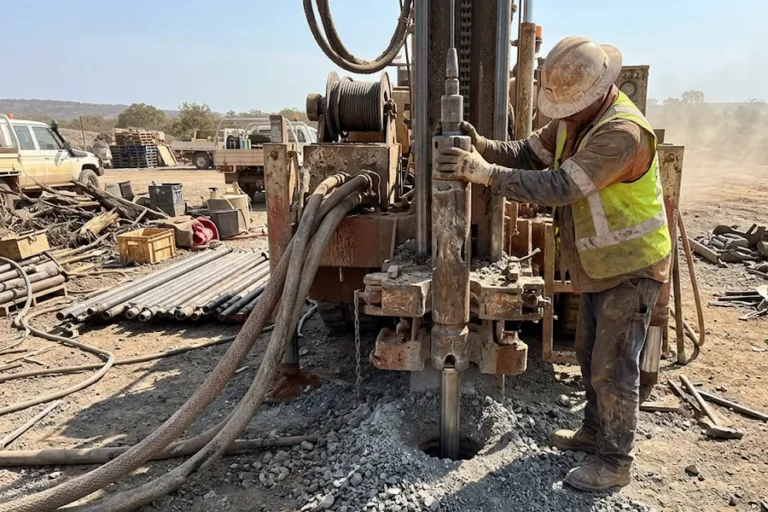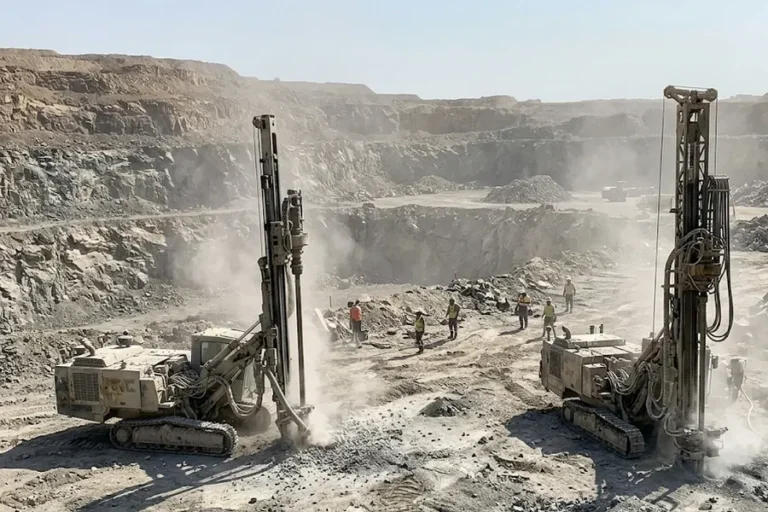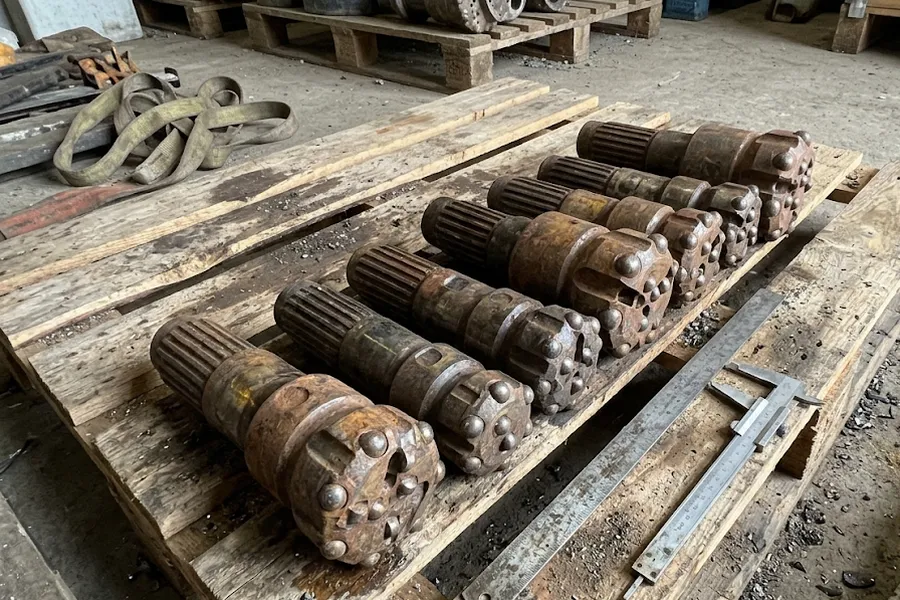
Picking a DTH drill bit size takes two checks. The bit diameter has to suit the hammer, and the shank has to fit the hammer’s chuck. This chart sets out typical bit diameters and common shank families for 3″ to 8″ hammers, then explains face and button shapes so you can order the right DTH button bits the first time.
How hammer size, shank and bit diameter fit together
A DTH hammer bit has two parts that matter for ordering. The shank is the splined end that slides into the hammer’s chuck (also called the driver sub). The head is the face that carries the carbide buttons and sets the hole diameter.
- Nominal hammer size (3″, 4″, 5″, 6″, 8″) is a size class. It roughly matches the smallest hole the hammer can drill.
- Shank family (DHD, QL, SD, COP, Mission and others) is the fitting standard. It must match your hammer exactly.
- Bit diameter is the hole size you get. Each shank family is made in a range of head diameters.
Atlas Copco’s long-standing sizing rule is a good starting point. The smallest hole a DTH hammer can drill is its nominal size. For production drilling, the largest bit is about the nominal size plus 25 mm (1″). Go larger and the gap around the hammer gets too wide for the return air to lift cuttings well.
DTH drill bit size chart
The ranges below are typical. They combine published figures from Epiroc, Mincon, Rockmore, Boart Longyear, Mitsubishi Materials and Numa, and manufacturers differ. Always confirm against the data sheet for your exact hammer model.
| Nominal hammer size | Common shank families in this class | Typical bit diameter (mm) | Typical bit diameter (in) |
|---|---|---|---|
| 3″ | DHD3.5, COP 32 / COP 34, Mission M30 | 85–105 | 3 3/8–4 1/8 |
| 4″ | DHD340, QL40, SD4, COP 44, TD40, Mission M40 | 105–130 | 4 1/8–5 1/8 |
| 5″ | DHD350R, QL50, SD5, COP 54, Mission M50 | 127–152 (often 133–152) | 5–6 |
| 6″ | DHD360, QL60, SD6, COP 64, Mission M60 | 152–203 (blasthole work often 156–178) | 6–8 |
| 8″ | DHD380, QL80, SD8, COP 84, Mission M80 | 203–254 (some makers list larger) | 8–10 |
Some notes on reading the chart:
- Shanks in the same row are not automatically interchangeable. A QL50 bit and an SD5 bit both suit 5″ hammers, but spline count, length and diameter can differ. Order by the shank your hammer’s manual names.
- Numa Patriot hammers in these sizes are commonly listed with QL-type shanks. The Patriot 60, for example, is published for QL60 bits, with a version for 360-type (DHD360) bits. Numa’s own shank designations, such as Numa 100 and Numa 120/125, appear on larger hammers above 8″.
- Model limits are tighter than class limits. Epiroc, for example, lists the COP 44 Gold at 110–130 mm, the COP 54 Gold at 134–152 mm and the COP 64 Gold at 156–178 mm. A slim or heavy-duty version of the same hammer can have a different window.
- Bits wear smaller. As gauge buttons wear, the hole shrinks. Atlas Copco notes that the hammer’s outside diameter becomes the limit, because a smaller hole restricts the airflow past the hammer. Do not run a bit so far under size that the hammer binds.
Bit face shapes: flat, convex and concave
The face is the front of the bit head where the buttons sit. Its profile affects penetration speed, hole straightness and how easy the bit is to regrind. Boart Longyear sums it up as convex for higher penetration rates, concave for straighter holes and flat for easy sharpening and maintenance. Sandvik also lists a “bulldog” face for some ranges.
| Face shape | What it does well | Typical use |
|---|---|---|
| Flat | Strong, simple face. Easy to regrind evenly. | Hard and abrasive rock, where button support matters most. |
| Convex (dome) | Fast penetration. Less load on the outer gauge buttons and less steel wash at the edge. | Soft to medium rock. Watch hole deviation in deeper holes. |
| Concave | Centre recess guides the bit and helps keep the hole straight. | General purpose, medium-hard and uniform rock. |
| Drop centre / deep concave | Deeper centre recess for more aggressive guidance and flushing. | Softer to medium rock, often at lower air pressure. |
ATR supplies DTH bits from 85 mm to 254 mm in flat, convex and concave faces.
Button shapes: spherical and ballistic
The buttons are tungsten carbide inserts pressed into the bit face. Two shapes cover most orders.
- Spherical (dome) buttons have a rounded tip. They spread the impact load and resist chipping, so they last longer in hard, abrasive rock.
- Ballistic (pointed) buttons have a taller, sharper profile. They cut faster in softer and medium rock, but they are more prone to breakage in very hard ground.
Many bits mix the two, with ballistic buttons on the face and spherical buttons on the gauge row where wear is highest. Carbide grade matters too. Sandvik, for example, lists four grades for its DTH bits (XT48, DP55, DP65 and PowerCarbide SH69), so ask which grade a quoted bit uses.
How to choose a bit for your job
- Start with the hammer. Note the brand, model and shank from the hammer’s manual or the stamp on your current bit.
- Set the hole size. Pick a diameter inside the hammer’s published window. For water wells, size the hole for the casing you plan to run, plus room for gravel pack or grout.
- Match the rock. Hard and abrasive: flat face, spherical buttons. Soft to medium: convex or concave face, ballistic buttons. Mixed or fractured ground where straightness matters: concave.
- Plan regrinding. Flat faces are easiest to regrind. Regrinding buttons before wear flats get large keeps penetration up and extends bit life.
Frequently asked questions
What size bit does a 4-inch DTH hammer take?
Typically 105–130 mm (about 4 1/8″ to 5 1/8″). The exact window depends on the model. The shank must match the hammer, for example DHD340, QL40, SD4 or COP 44.
Can I fit a larger bit to get a bigger hole?
Only within the hammer’s published range. As a rule of thumb, the maximum bit for production drilling is the nominal hammer size plus about 25 mm. Beyond that, the return air slows and cuttings are not cleared well, which cuts penetration and wears the bit faster.
Which face shape is best for hard rock?
A flat face with spherical buttons is the usual choice for hard, abrasive rock. It gives the buttons the most steel support and is easy to regrind. Concave is a good general option when hole straightness matters.
Are DHD, QL and SD bits interchangeable?
Not by default. They are separate shank standards, even when they sit in the same size class. Check your hammer’s manual or ask your supplier to confirm the fit before you order.
Get the right DTH bit
ATR supplies DTH hammers from 3″ to 8″ and button bits from 85 mm to 254 mm. See the range on our DTH drilling tools page, or read our guide to choosing a DTH hammer in South Africa. Send us your hammer model, shank, hole size and rock type through the contact page and we will match a bit to it.